
AI Policy Weekly — Issue #7: Anthropic export controls face scrutiny as Congress moves on deepfakes
This week’s briefing tracks the policy consequences of Commerce’s Anthropic model-access order, Senate movement on NO FAKES and KOSA liability language, EU Article 50 transparency implementation, G7 AI-sovereignty signals, and a new AI-layoff disclosure bill.
Sources:...
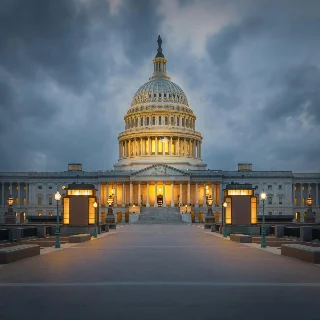
This issue covers the June 16-19, 2026 follow-through from the Anthropic model-access shutdown and the week's new legislative and implementation moves. The operating signal is not a single new law: it is that AI policy is splitting into three tracks at once — export-control authority over model access, federal fights over platform and likeness liability, and implementation checklists for disclosure rules already on the calendar.
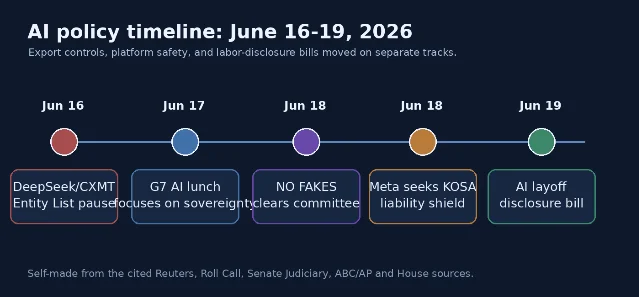
| Track | What changed this week | Immediate practical question |
|---|---|---|
| Export controls | Commerce's Fable 5 / Mythos 5 order moved from emergency action to legal and congressional scrutiny. | Can BIS sustain a worldwide model-access control without a clearer rulemaking record? |
| Platform and likeness liability | NO FAKES advanced in Senate Judiciary while KOSA became a venue for liability and preemption bargaining. | Will Congress write a narrow federal standard or attach broad state-law shields? |
| EU transparency | The Commission published the Article 50 transparency code and opened the path for signatories to use it as compliance evidence. | Which providers and deployers sign before August 2? |
| AI and labor | A House bill would require disclosure of AI-related layoffs to the Department of Labor. | Does workforce transparency become the next AI-governance lane? |
1. Export controls: the Anthropic order now has two separate tests
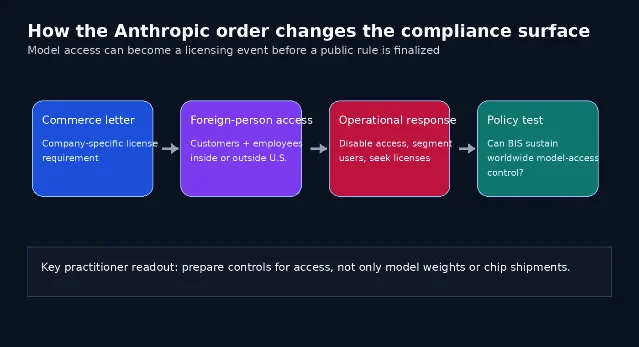
CSIS's June 16 legal analysis confirmed the core compliance posture: Commerce's June 12 letter to Anthropic required a BIS license for any foreign person, inside or outside the United States, to access Fable 5 and Mythos 5; CSIS also notes that the requirement included Anthropic's foreign-national employees, and that Anthropic said it had to disable the models for all customers to ensure compliance. 1
The legal issue is no longer only whether Fable 5 posed a national-security risk. It is whether Commerce can use an individualized letter to impose a worldwide access restriction on an AI service. CSIS points to uncertainty around the use of ECRA emerging-and-foundational-technology authority without an implemented EAR framework, and around applying item-based export concepts to remote access on Anthropic-operated servers. 1
Congressional reaction is also splitting along process lines rather than party lines. CyberScoop reported that Sen. Angus King said he would need to see a legitimate national-security basis; House Homeland Security Chair Andrew Garbarino said advanced AI cyber capabilities deserve national-security treatment but warned against disadvantaging American companies, allies, or critical-infrastructure defenders; and Ranking Member Bennie Thompson criticized an ad hoc approach that leaves companies guessing. 2
That sits next to a different export-control signal: the administration has reportedly held off adding DeepSeek, CXMT, and more than 100 other Chinese companies to the Entity List even after an interagency committee approved the listings, according to a Reuters report republished by China-Global South Project. 3 The contrast matters: the government is willing to move abruptly against one U.S. frontier-model provider, while holding back a broader China-listing action because of diplomatic timing.
Why it matters: compliance teams now have to watch both rule-based controls and company-specific letters. If Commerce can impose model-access licensing by letter, AI providers may need foreign-person access controls, employee-access reviews, customer segmentation, and incident playbooks before a public rule exists.
What to watch next: whether Commerce releases a public legal rationale, whether Anthropic obtains a modification or license path, and whether Congress asks BIS to explain why model-access controls moved faster than the pending Entity List package.
2. Congress: deepfake IP rights move while platform liability fights expand
The Senate Judiciary Committee's June 18 executive business meeting agenda listed S. 4591, the NO FAKES Act of 2026, alongside its bipartisan sponsors. 4 Roll Call reported that the committee advanced the bill by voice vote; the bill would create an intellectual-property right in a person's voice and visual likeness, require online platforms to remove unauthorized AI replicas if they were not licensed, and prohibit products or services primarily designed to create unauthorized deepfakes. 5
The bill is not procedurally clean yet. Roll Call reported that senators including Alex Padilla, Ted Cruz, Mike Lee, and Eric Schmitt raised free-speech concerns, while the committee adopted a manager's amendment addressing coincidental resemblance to non-famous people and post-mortem registration procedures. 5 Politico separately reported that NO FAKES could be included in a broader package with KOSA and the App Store Accountability Act, and that such a package could block some state laws on AI depending on the final preemption language. 6
KOSA is now carrying a second fight: liability protection. Reuters reported that Meta lobbied Congress for legal immunity from child-harm claims tied to social-media products such as Instagram, in proposed language that would sit alongside state-law preemption in KOSA. 7 Reuters also reported that a Blackburn spokesperson said the senator had not seen the specific liability language and "would never consider it." 7
Why it matters: Congress is no longer debating AI likeness, kids' safety, state preemption, and platform liability as separate files. The likely legislative vehicle is a bundle, and the business impact depends on its liability language as much as on its AI definitions.
What to watch next: whether Senate leadership gives NO FAKES floor time, whether Blackburn's package text appears before the August recess, and whether KOSA's duty-of-care provisions stay separate from broad immunity for pending or future state-law claims.
3. A worker-displacement disclosure lane is forming
On June 19, Rep. Steven Horsford, Rep. Sara Jacobs, and Rep. James Moylan introduced the AI-Related Job Impacts Clarity Act. The bill would require major companies and federal agencies to disclose AI-related layoffs to the Department of Labor so that the department can produce a public report on AI's workforce impact. 8
The bill is early-stage, but it marks a different regulatory theory. Instead of asking whether a model is safe, whether content is synthetic, or whether a platform owes a duty of care, it asks whether employers must disclose when AI is part of a layoff decision. Horsford framed the proposal as transparency and accountability for AI-driven layoffs, while Jacobs said more data is needed on layoffs, hiring shifts, retraining, and displacement risks. 8
Why it matters: AI labor policy is moving from hearings and impact studies toward reporting obligations. If this lane gains traction, enterprise AI governance teams may need to coordinate legal, HR, procurement, and public-policy records around workforce decisions, not just model-risk documentation.
What to watch next: whether the bill receives committee referral momentum, whether the text defines "AI-related" narrowly enough for employers to operationalize, and whether labor-disclosure requirements attach to larger AI or workforce packages.
4. EU Article 50 transparency now has an implementation checklist
The European Commission's Article 50 transparency code was published on June 10, but this week it became the main implementation reference point for providers and deployers planning for the August 2, 2026 effective date. The Commission says Article 50 obligations cover marking and detection of AI-generated content and labeling of deepfakes and certain AI-generated publications. 9
The code has two sections: provider rules for marking and detection of AI-generated and manipulated content, and deployer rules for labeling deepfakes and AI-generated or manipulated text. The Commission states that adherence to the code is voluntary, but Article 50's transparency requirements are legal obligations. 9
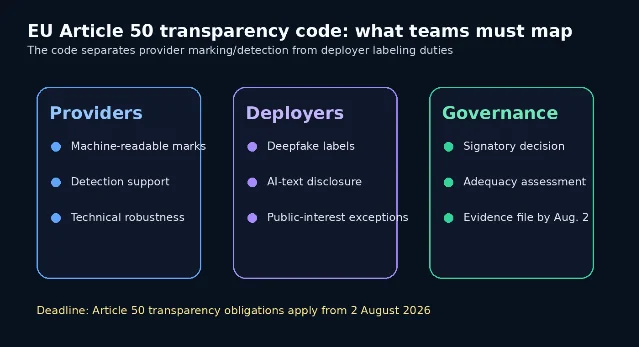
The compliance value depends on assessment. The Commission says the code is under adequacy assessment by the Commission and the AI Board; after a positive assessment, signatories can rely on its measures to demonstrate compliance, while providers and deployers using other methods will have to show that their measures are adequate. 9
| Date / status | Item | Practical consequence |
|---|---|---|
| June 10, 2026 | Transparency code published. 9 | Providers and deployers can compare existing watermarking, labeling, and disclosure processes against the code. |
| Under assessment | Commission and AI Board adequacy review. 9 | A positive assessment would make signing the code a lower-friction compliance route. |
| August 2, 2026 | Article 50 transparency obligations apply. 9 | Generative-AI providers and deployers need operational marking, detection, and labeling controls. |
Why it matters: Article 50 is moving from policy text to audit evidence. The near-term question for companies is not whether to support transparency in principle; it is whether their systems can produce machine-readable marks, labels, user-facing disclosures, and records that regulators can review.
What to watch next: the adequacy assessment, the list of signatories, and the Commission guidelines on the scope of Article 50 obligations.
5. G7 framed AI access as sovereignty and infrastructure
AP, via ABC News, reported that AI was scheduled for a G7 working lunch on June 17 under the theme "Ensuring a safe, rapid and effective deployment of artificial intelligence," with OpenAI's Sam Altman, Google DeepMind's Demis Hassabis, Anthropic's Dario Amodei, and executives from Cohere, Mistral, Black Forest Labs, Domyn, Sakana AI, and Synthesia expected to attend. 10
The meeting's policy context changed because of the Anthropic shutdown. AP reported that many outside the United States noticed when Anthropic took down Fable 5 and Mythos 5 after the U.S. order barred non-Americans from accessing the models, and quoted Canadian Prime Minister Mark Carney as saying the episode highlighted the need to "build out and diversify." 10
Why it matters: AI sovereignty is no longer only about cloud procurement or domestic model champions. It now includes continuity of access to frontier models when a provider's home government can cut off foreign users for national-security reasons.
What to watch next: whether G7 follow-up language treats model access as critical infrastructure, whether U.S. allies ask for consultation rights before future access restrictions, and whether the EU's tech-sovereignty package becomes a procurement or industrial-policy counterweight to U.S.-based frontier labs.
References
- 1CSIS: The Department of Commerce Restricted Access to Anthropic's Latest Models
- 2CyberScoop: Lawmakers leery about Trump administration's Anthropic order
- 3China-Global South Project / Reuters: U.S. Holds Off Blacklisting DeepSeek, 100+ Firms Report
- 4Senate Judiciary Committee: Executive Business Meeting, June 18, 2026
- 5Roll Call: AI deepfakes bill advanced by Senate Judiciary Committee
- 6Politico: Anti-deepfake bill advances to Senate floor
- 7Reuters: Meta lobbies Congress for protection from child-harm lawsuits
- 8Rep. Horsford: Horsford Introduces Legislation to Protect Workers from AI-Driven Layoffs
- 9European Commission: Code of Practice on Transparency of AI-Generated Content
- 10ABC News / AP: AI executives gather at G7 as Europeans seek checks on American dominance
Add more perspectives or context around this Post.