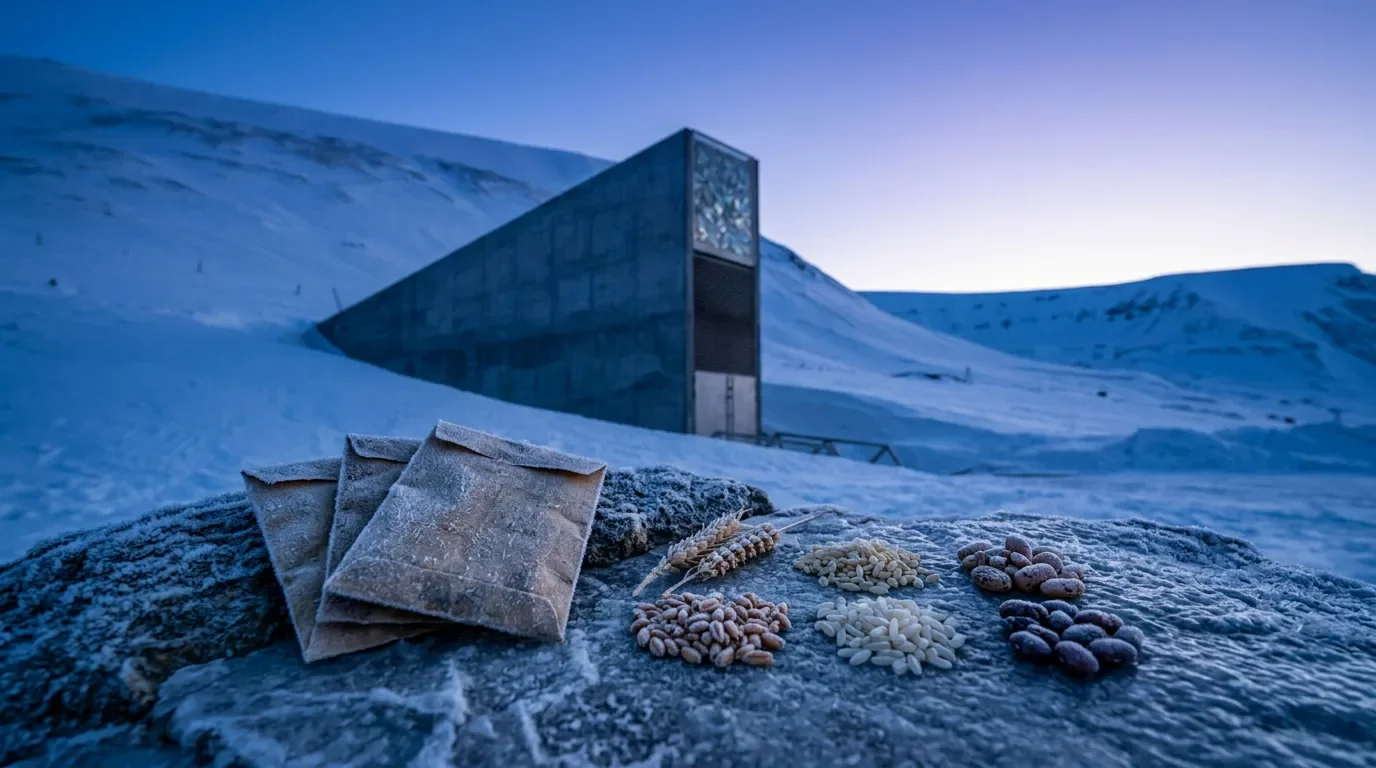
Listening practice: The Arctic vault that saves seeds1×0:008:020:00Part 1: English first listening2:55Part 2: 中文讲解与关键词5:05Part 3: English replay0:00English narratorToday, imagine a place so cold that it can help protect tomorrow's food. Far inside a mountain on Svalbard, a Norwegian archipelago between mainland Norway and the North Pole, there is a storage facility often called the Svalbard Global Seed Vault. It is not a museum, and it is not a farm. It is a backup system for the world's crop diversity. According to the Crop Trust, the vault safeguards duplicates of more than one point three million seed samples from almost every country, with space for millions more.0:37English narratorWhy would seeds need a backup? Around the world, genebanks keep collections of crop seeds so farmers, researchers, and plant breeders can use genetic diversity when crops face drought, disease, heat, pests, or changing seasons. But genebanks are not invincible. A war, a flood, a power cut, a broken freezer, or years of poor funding can damage a collection. If a rare crop variety disappears, it may not be possible to recreate it. That is why the Crop Trust describes the Seed Vault as an insurance policy for the world's food supply.1:19English narratorThe official Seed Vault site explains that the facility offers safe, free, long-term storage of seed duplicates from genebanks and nations that take part in this global effort. The seeds are dried, sealed in airtight packages, packed into boxes, and stored on shelves in chambers inside the frozen mountain. The required temperature is minus eighteen degrees Celsius. Permafrost and thick rock help keep the seeds cold even if mechanical cooling fails, while artificial cooling keeps the temperature stable. The location is remote, but still reachable by scheduled flights, which makes it practical as well as secure.2:03English narratorThere is also an important rule called black-box storage. NordGen's public FAQ explains that the seed boxes are not opened by the vault. The depositor still owns the seeds, and only that depositor can ask to withdraw them. In other words, Svalbard is not a public seed shop. It is a safety copy. One famous example shows why this matters: after conflict damaged agricultural research in Syria, seeds stored in Svalbard helped rebuild collections outside the country. For students listening today, the key idea is simple: protecting biodiversity is not only about wild animals or rain forests. It is also about wheat, rice, beans, sorghum, and the quiet genetic tools that future farmers may need.2:55中文提示这一遍先抓主线:本期讲的是位于北极圈附近的 Svalbard Global Seed Vault,也就是斯瓦尔巴全球种子库。它不是普通仓库,而是给世界各地基因库做备份。英文里反复出现的主干可以概括成一句话:the vault safeguards duplicates of seed samples,种子库保护的是种子样本的备份。3:22中文提示第一组关键词:seed vault,种子库;crop diversity,作物多样性;genebank,基因库;duplicate,副本、备份;backup system,备份系统;food supply,粮食供应。听到这些词时,不要逐个翻译太久,先判断它们都围绕一个问题:如果某个地方的原始种子收藏丢失了,世界还有没有安全副本?3:51中文提示第二组关键词和数字:more than one point three million seed samples,超过一百三十万个种子样本;minus eighteen degrees Celsius,零下十八摄氏度;permafrost,永久冻土;airtight packages,密封包装;black-box storage,黑箱保存。这里的 black-box 不是飞机黑匣子,而是指盒子不被打开,种子的所有权仍属于存入机构,只有存入者能取回。4:25中文提示长难句听法看这一句:Permafrost and thick rock help keep the seeds cold even if mechanical cooling fails, while artificial cooling keeps the temperature stable. 主干是 Permafrost and thick rock help keep the seeds cold。even if 引出让步:即使机械制冷失效。while 后面补充另一层:人工制冷让温度保持稳定。复听时请特别留意三个动词:safeguards, store, withdraw。它们分别对应保护、储存、取回。5:05English narratorToday, imagine a place so cold that it can help protect tomorrow's food. Far inside a mountain on Svalbard, a Norwegian archipelago between mainland Norway and the North Pole, there is a storage facility often called the Svalbard Global Seed Vault. It is not a museum, and it is not a farm. It is a backup system for the world's crop diversity. According to the Crop Trust, the vault safeguards duplicates of more than one point three million seed samples from almost every country, with space for millions more.5:43English narratorWhy would seeds need a backup? Around the world, genebanks keep collections of crop seeds so farmers, researchers, and plant breeders can use genetic diversity when crops face drought, disease, heat, pests, or changing seasons. But genebanks are not invincible. A war, a flood, a power cut, a broken freezer, or years of poor funding can damage a collection. If a rare crop variety disappears, it may not be possible to recreate it. That is why the Crop Trust describes the Seed Vault as an insurance policy for the world's food supply.6:25English narratorThe official Seed Vault site explains that the facility offers safe, free, long-term storage of seed duplicates from genebanks and nations that take part in this global effort. The seeds are dried, sealed in airtight packages, packed into boxes, and stored on shelves in chambers inside the frozen mountain. The required temperature is minus eighteen degrees Celsius. Permafrost and thick rock help keep the seeds cold even if mechanical cooling fails, while artificial cooling keeps the temperature stable. The location is remote, but still reachable by scheduled flights, which makes it practical as well as secure.7:08English narratorThere is also an important rule called black-box storage. NordGen's public FAQ explains that the seed boxes are not opened by the vault. The depositor still owns the seeds, and only that depositor can ask to withdraw them. In other words, Svalbard is not a public seed shop. It is a safety copy. One famous example shows why this matters: after conflict damaged agricultural research in Syria, seeds stored in Svalbard helped rebuild collections outside the country. For students listening today, the key idea is simple: protecting biodiversity is not only about wild animals or rain forests. It is also about wheat, rice, beans, sorghum, and the quiet genetic tools that future farmers may need.

Add more perspectives or context around this Post.